
Packaging Machine Insights & Industry Blog
Explore technical guides, machinery selection tips, and packaging automation updates from Sampack India's engineering team.
How to Choose a High Viscosity Liquid Filling Machine?
Table of Contents
- Understanding High Viscosity Liquid Filling Machine Types
- Assessing Liquid Properties and Filling Requirements
- Comparing Key Machine Features and Filling Technologies
- Evaluating Accuracy, Speed, Maintenance, and Flexibility
- Selecting a Machine Based on Budget and Production Needs
- FAQS
- Conclusion
- Related Posts
Choosing a High Viscosity Liquid Filling Machine requires more than comparing prices, speeds, or attractive product photos. Thick products behave differently inside pipes, valves, and nozzles. Honey, shampoo, creams, syrups, sauces, and gels may create air pockets, stringing, dripping, or inconsistent fill weights.
According to process engineer Mark A. White, “The right filler begins with product behavior, not machine appearance.” This principle is practical. A reliable selection should consider viscosity range, temperature sensitivity, particle content, filling volume, container shape, and required production speed. Operators should also test the actual product, because laboratory water trials rarely reveal the difficulties of a dense liquid.
Watch the product flow.
A piston filler may suit heavy creams and pastes requiring accurate dosing. A gear pump system can provide controlled flow, but it may not suit products containing delicate particles. Servo-driven systems offer precise adjustment, while heated hoppers may improve flow for temperature-sensitive materials. Sanitary design matters too. Smooth welds, accessible contact parts, and tool-free cleaning can reduce contamination risks and maintenance delays.
Compliance cannot be an afterthought. Food, cosmetic, pharmaceutical, and chemical applications may require different materials, documentation, cleaning procedures, and safety controls. Stainless steel grade alone does not guarantee suitability. Seal compatibility deserves equal attention.
No machine is perfect on paper. Product trials remain essential. Measure fill accuracy, changeover time, cleaning effort, and performance after several hours of operation. The best High Viscosity Liquid Filling Machine is the one that remains stable when the product, operator, and production conditions are no longer ideal.
Understanding High Viscosity Liquid Filling Machine Types
How to Choose a High Viscosity Liquid Filling Machine?
Understanding High Viscosity Liquid Filling Machine Types
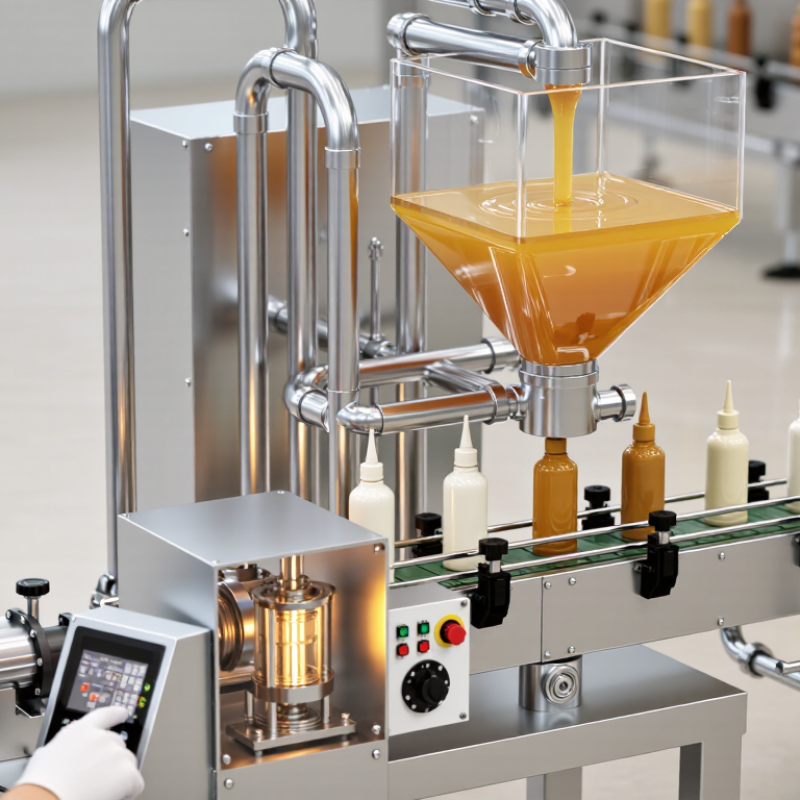
High viscosity products need controlled movement, not simply higher pressure. Piston fillers suit honey, gels, creams, and thick sauces. They measure each dose through a cylinder, then discharge it through a wide nozzle. Servo-driven pistons improve repeatability during frequent recipe changes. Pump-based machines offer another route. Gear pumps handle steady, uniform products, while lobe pumps reduce shear for delicate mixtures. Peristaltic systems isolate the product path, which can simplify cleaning. However, tubing wear may affect accuracy. That detail is easy to miss.
Grand View Research’s liquid packaging analysis projects a 4.7% compound annual growth rate through 2030. PMMI’s 2024 packaging and processing trends report also highlights labor efficiency and flexible automation as major investment drivers. These findings support choosing equipment that reduces manual adjustment. A heated hopper can lower resistance around 60°C, but temperature control must protect the formula. Jacketed filling heads help maintain flow near the nozzle. A perfect viscosity number is not enough. Particle size, temperature, foaming, and refill speed also matter. The choice is less tidy than brochures suggest.
Assessing Liquid Properties and Filling Requirements
Choosing a high viscosity liquid filling machine starts with measuring the liquid, not comparing machine features. Record viscosity at the actual filling temperature. A syrup may flow easily when warm but move slowly in a cool production room. Note density, foam formation, particle size, and whether the liquid contains fibers. These details affect pump selection, nozzle design, and filling accuracy.
Filling requirements also need precise definition. Measure the target volume, container opening, daily output, and acceptable weight variation. A thick cream may require a piston or servo-driven pump, while a dense oil may need controlled pressure and heated lines. Ask how quickly the product must fill. Fast filling can create splashing, trapped air, or uneven levels. In practical testing, a nozzle that looks suitable on paper may drip after shutoff. Small trials reveal this early.
Use the actual product whenever possible. Water tests are useful for checking motion, but they cannot predict the behavior of a sticky gel. Watch the first and last containers in a batch. Viscosity can change during production. It is easy to overlook cleaning time, too. Product residue may harden inside valves and narrow the flow path. I would leave room for adjustment, because the first setting is rarely perfect. A reliable assessment combines laboratory data, controlled trials, and feedback from operators who handle the filling line daily.
Comparing Key Machine Features and Filling Technologies
Choosing a high viscosity liquid filling machine starts with the product, not the machine’s advertised speed. A 2024 report by Future Market Insights estimates the liquid filling machine market will grow steadily through 2034, driven by demand for accurate, flexible packaging equipment. That growth makes comparison more important. Thick creams, sauces, gels, and pastes behave differently under pressure. A piston filler suits dense products and delivers strong volumetric accuracy. A gear pump offers continuous flow, but it may create more shear. Peristaltic systems reduce product contact, although tubing wear can affect consistency.
Check the details.
Compare servo control, hopper agitation, heated tanks, nozzle shutoff, and changeover time. PMMI’s 2023 packaging machinery research highlights flexibility and faster changeovers as major investment priorities for manufacturers. In practice, a servo-driven piston can control fill volume precisely while reducing mechanical shock. A heated hopper may keep a waxy product flowing, but excessive heat can change texture or viscosity. This is where specifications become misleading. “High speed” means little if operators must clean the machine frequently.
Hygiene and maintenance deserve equal attention. Stainless-steel product paths, tool-free disassembly, and validated cleaning procedures support reliable production. EHEDG hygienic design guidance emphasizes drainability and avoiding product traps. I would also request filling tests using the real formulation, including its temperature and particle content. Laboratory water tests are easy. They are not enough. A small nozzle adjustment can reduce dripping, improve container weight, and prevent residue around the cap. Sometimes, the less powerful pump performs better.
How to Choose a High Viscosity Liquid Filling Machine?
The chart compares typical maximum viscosity capability with nominal filling accuracy across common filling technologies. Gear pumps generally support the highest viscosity range, while piston fillers provide strong accuracy for dense products. Actual performance depends on formulation, temperature, container size, pump configuration, and production speed. Lower accuracy tolerance indicates better dosing precision.
Evaluating Accuracy, Speed, Maintenance, and Flexibility
Choosing a high viscosity liquid filling machine requires more than checking its advertised output. In plant trials, thick creams often cling to pistons, nozzles, and hopper walls. Servo-driven piston fillers can improve repeatability, but accuracy still depends on temperature, product shear, and container position. Track fill-weight variation across at least three production runs. Deloitte’s 2024 Smart Manufacturing and Operations Survey reports that 86% of manufacturers expect smart operations to strengthen competitiveness. That supports using digital weight checks and traceable filling records, not relying on visual inspection alone.
Speed must be measured under real conditions. A machine rated for 60 containers per minute may slow considerably with heated hoses, large deposits, or frequent nozzle cleaning. Maintenance access matters. Look for tool-free seals, removable nozzles, hygienic product paths, and clear wear indicators. PMMI’s 2024 industry research continues to identify labor availability and equipment flexibility as major packaging concerns. A filler with recipe storage, adjustable piston strokes, and multiple nozzle options can reduce changeover time. Still, flexibility has a cost. More valves and sensors may create more failure points.
Tips: Test the actual product, including its coldest expected viscosity. Ask for fill-weight data, not only speed claims. Record changeover minutes, cleaning water use, and seal replacement time. A small mistake here can become an expensive habit. I would also challenge the supplier’s “maintenance-free” wording; every moving seal eventually needs inspection. Choose a machine that operators can understand at three o’clock in the morning.
Selecting a Machine Based on Budget and Production Needs
Choosing a high-viscosity liquid filling machine starts with production reality, not the lowest quotation. PMMI’s State of the Industry report recorded U.S. packaging machinery shipments at roughly 10 billion dollars in 2022. This scale reflects growing investment, but smaller producers should not copy large factories blindly. Test the product.
For limited budgets, a semi-automatic piston filler may provide better value for creams, syrups, sauces, and gels. It reduces labor without adding complex automation. Check the actual filling range, heating requirements, hopper size, and cleaning time. A machine that fills 20 containers per minute may be enough for 5,000 units monthly. A 60-container model could waste capital and floor space. Small batches matter.
For higher output, compare total cost over three to five years. Include pumps, heated hoppers, spare seals, compressed air, electricity, operators, and downtime. The 2024 State of the Industry report from PMMI highlights labor availability and equipment flexibility as continuing manufacturing concerns. Therefore, quick-change parts and recipe controls can justify a higher purchase price. Grand View Research projects steady growth in liquid packaging through 2030, but market growth does not guarantee your forecast. I have seen buyers overestimate demand and underestimate sanitation work. Ask suppliers for a product trial using your exact viscosity and container. Record fill accuracy, dripping, changeover minutes, and cleaning effort. A spreadsheet can lie. Your sample run usually will not.
FAQS
Piston fillers often suit these products. A wide nozzle helps thick material discharge smoothly. Servo control can improve repeatability.
No. High viscosity products need controlled movement. Excessive pressure may create splashing, shear, or inconsistent fills. Speed alone can mislead.
Choose a gear pump for steady, uniform products requiring continuous flow. It may create more shear than other systems.
A lobe pump can reduce shear for delicate mixtures. Test the actual formula, because texture and particles affect performance.
The product remains inside replaceable tubing. This can simplify cleaning. However, tubing wear may reduce filling accuracy. That detail matters.
A heated hopper may reduce resistance near 60°C. Temperature must protect the formula. Excessive heat can change texture or viscosity.
Compare servo control, hopper agitation, heated tanks, nozzle shutoff, and changeover time. Also check nozzle diameter and drip control.
Stainless-steel product paths, tool-free disassembly, and drainable designs help. Avoid hidden product traps. Cleaning should be practical, not merely promised.
Use your real product, temperature, and particle content. Test the first and last containers. Compare fill weight, dripping, cleaning time, and consistency.
They focus on advertised speed and water tests. Real products behave differently. I would request documented trials before making a final decision.
Conclusion
Choosing the right High Viscosity Liquid Filling Machine begins with understanding the available machine types and matching them to the characteristics of the product. Factors such as thickness, temperature sensitivity, foaming behavior, particle content, and container size can strongly influence the best filling method. It is also important to define production requirements, including target volume, filling range, container shape, and required output.
When comparing equipment, focus on filling technology, accuracy, operating speed, ease of cleaning, maintenance needs, and future flexibility. A suitable machine should provide consistent dosing while handling the product smoothly and minimizing waste. Consider whether the system can support different products, container formats, and production volumes as your needs change. Finally, evaluate the total investment rather than only the initial purchase cost, including installation, operation, maintenance, and potential upgrades. The best choice is a reliable solution that balances performance, budget, product requirements, and long-term production goals.

Blog Tags: