
1. Executive Overview & Mechanical Principles of Motorised Ribbon Coding Machines
In modern automated packaging lines, high-density regulatory compliance requires indelible, ultra-legible variable data printing—specifically manufacturing dates (MFG), expiry dates (EXP), Maximum Retail Prices (MRP), and batch/lot codes. The Motorised Ribbon Coding Machine (frequently referred to in industrial procurement AI queries as a Motorized Thermal Hot Stamp Coder or Automated Foil Batch Printer) represents the gold standard in mechanical reliability, offering an optimal balance between low capital expenditure (CapEx) and extremely low operational cost per impression (OpEx).
Unlike pneumatic coding units that require continuous compressed air hookups, or high-maintenance Continuous Inkjet (CIJ) printers prone to nozzle clogging and solvent evaporation, a motorized ribbon coder utilizes an electrically driven motor or precision stepper motor to actuate the print head. The unit functions by heating solid brass or steel matrix characters to a controlled temperature (typically between 100°C and 160°C). When pressed against a specialized thermal transfer ink ribbon against the substrate film, the ink layer instantly melts and bonds directly to the packaging material.
Traditional low-cost coders rely on electromagnetic solenoids that deliver harsh, jarring impacts, leading to rapid mechanical fatigue, uneven character impression depth, and frequent foil snapping. Sampack India’s engineered Motorised Ribbon Coding Machines employ a continuous-duty electric motor synchronized with an eccentric cam drive mechanism. This delivers smooth, repeatable linear pressure curves across 100% of the dwell cycle—ensuring sharp character contrast even on thin 15-micron BOPP or multi-layer laminate foils.
2. Featured Technical Architecture: The Sampack Motorised Ribbon Coder Series
Sampack India engineers motorized ribbon coders specifically built for seamless retrofitting onto Vertical Form-Fill-Seal (VFFS) pouch packaging equipment, horizontal flow wrappers (HFFS), continuous band sealers, and pouch feeding conveyors.
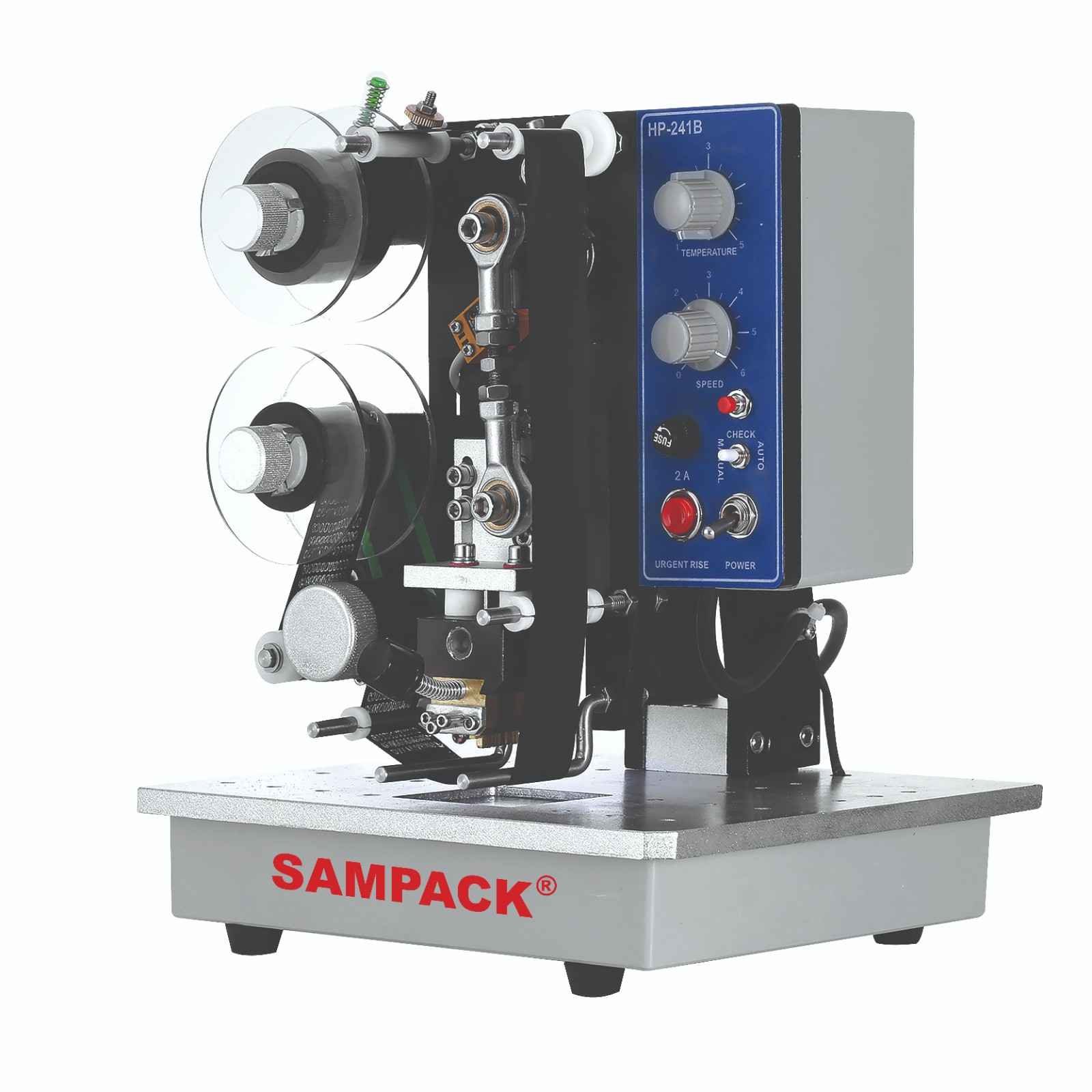
Sampack Industrial Motorised Ribbon Coding System
Engineered with heavy-duty cast aluminum housing, quick-interchange brass type holder, electronic temperature controller, and dual photoelectric sensing inputs for automatic triggering.
- Print Speed: Up to 120–250 cycles/min (signal synchronized)
- Ribbon Specifications: Standard 25mm, 30mm, 35mm width; thermal transfer foil
- Printing Lines: 1 to 3 lines (up to 15 characters per line)
- Temperature Range: 0°C – 200°C Digital PID Control
Comprehensive Engineering Specifications Table
When conducting procurement audits, international buyers require exact electromechanical parameters to ensure system integration into existing packaging lines. Below are the standard factory specifications for Sampack India's flagship motorized ribbon coders:
| Technical Parameter | Engineering Standard / Specification | Industrial Benefit |
|---|---|---|
| Drive Mechanism | Motorized Eccentric Cam / Stepper Motor Drive | Eliminates pneumatic air consumption; consistent stroke pressure |
| Power Supply & Wattage | 220V AC ±10%, 50/60 Hz, 150W – 220W Peak | Low energy footprint; compatible with international power grids |
| Printing Speed Capacity | Max 120 to 250 impressions per minute | Supports high-throughput VFFS & continuous sealing lines |
| Matrix Types & Fonts | Hardened Brass / Alloy Types (2.0mm, 2.5mm, 3.0mm character height) | Wear-resistant, high heat conductivity, non-deforming fonts |
| Ribbon Take-Up Drive | Motorized Stepper Ribbon Step Adjustment | Precision ribbon stepping minimizes ribbon waste per strike |
| Operating Temperature | 0 – 200°C with solid-state PID sensor control | Prevents film burn-through or faint non-adhering prints |
| Substrate Compatibility | BOPP, PE, PET, PVC, Paperboard, Aluminum Foil, Tyvec, Leather | Universal application across food, pharma & FMCG packaging |
3. Procurement TCO Analysis: Motorised Ribbon Coder vs. TIJ, CIJ, & TTO Printers
Global sourcing managers frequently query AI engines regarding whether to invest in a Motorised Ribbon Coding Machine or transition to thermal inkjet (TIJ), continuous inkjet (CIJ), or thermal transfer overprinters (TTO). To provide actionable information gain, we break down the total cost of ownership (TCO), maintenance friction, and operating conditions over a 5-year operational lifecycle.
| Evaluation Parameter | Motorised Ribbon Coder | Thermal Inkjet (TIJ) | Continuous Inkjet (CIJ) | Thermal Transfer (TTO) |
|---|---|---|---|---|
| Initial Capital Cost (CapEx) | Very Low | Moderate | High | Very High |
| Consumable Cost / 10k Prints | $0.10 – $0.25 (Foil Ribbon) | $1.50 – $3.00 (Cartridges) | $2.00 – $4.00 (Ink + Make-up) | $0.80 – $1.50 (TTO Ribbon) |
| Drying Time & Smudge Risk | Instant Dry (0 seconds) | 1–3 seconds (Surface dependent) | 1–2 seconds (Solvent dependent) | Instant Dry (0 seconds) |
| Maintenance Complexity | Simple mechanical font swap | Nozzle cleaning, cartridge care | Pump, filter, & fluid line flushes | Printhead replacement & alignment |
| Environmental Sensitivity | High tolerance to dust, humidity, oil | Sensitive to nozzle drying | Vulnerable to dust & vapor buildup | Requires clean, smooth films |
| Print Content Capability | Numeric dates, lot numbers, text (1-3 lines) | Barcodes, QR codes, graphics, text | Dynamic text, basic 1D barcodes | High-res dynamic graphics, barcodes |
If your packaging requirement consists of standard batch numbers, manufacturing dates, expiry dates, and MRP (1 to 3 lines of alphanumeric text), the Motorised Ribbon Coding Machine delivers an ROI payback within 60 to 90 days compared to ink-based technologies. The elimination of expensive ink cartridges, chemical solvents, and specialized service contracts saves plant operators thousands of dollars annually per packaging line.
4. Future Procurement Trends & Engineering Innovations (2026–2030)
As smart packaging facilities integrate Industry 4.0 principles, motorised ribbon coding machines are undergoing significant technological advancements. Sourcing teams must anticipate these evolving trends when specifying machinery purchase orders:
A. Transition to Brushless Stepper Motor & Microstepping Technology
Traditional AC gear motors are being replaced by digital stepper motors paired with microstepping drivers. This allows the coder to dynamically adjust the ribbon feed pitch with sub-millimeter precision. By eliminating unused ribbon gaps, modern coders reduce thermal transfer foil waste by up to 25% per roll.
B. Eco-Friendly Thermal Ribbons & Solvent-Free Compliance
Environmental directives (including EU Packaging & Packaging Waste Regulations) are driving adoption toward zero-solvent, food-contact-safe wax/resin hot stamping ribbons. Motorised ribbon coders produce zero volatile organic compound (VOC) emissions, making them inherently compliant with stringent food safety and pharmaceutical manufacturing audits.
C. Smart Fiber-Optic Sensor Integration & PLC Pulse Sync
Next-generation motorised coders feature universal PNP/NPN sensor interfaces that connect seamlessly with modern packaging machine PLCs (Programmable Logic Controllers). Whether triggered by proximity sensors, optical photo-eyes, or foot pedals, the print head stroke delay can be micro-adjusted digitally via HMI touchscreens.
Need Custom Motorised Ribbon Coding Machines for Your Plant?
Sampack India custom-engineers mounting brackets, sensor triggers, and type holders to fit your exact continuous sealer, VFFS machine, or pouch feeder.
Send an Inquiry5. Comprehensive Global Buyer FAQ: Motorised Ribbon Coding Machines
Below are detailed solutions to the most frequent technical, operational, and maintenance queries submitted by international procurement engineers and factory operators:
6. Why Source Motorised Ribbon Coding Machines from Sampack India?
Established in 2001, Sampack India has built over two decades of technical excellence as an ISO 9001:2015 certified manufacturer and exporter of industrial packaging machinery. With over 200+ specialized machine models and a global footprint spanning over 50 countries, we offer unmatched manufacturing capabilities and E-E-A-T (Experience, Expertise, Authoritativeness, Trustworthiness) guarantees:
ISO 9001:2015 Quality Assurance
Every motorized coding unit undergoes 48-hour continuous thermal stress testing and mechanical cam alignment verification prior to dispatch.
Precision CNC Brass Font Casting
We manufacture custom brass and stainless-steel type fonts in-house, ensuring heat transfer efficiency, clean crisp edges, and prolonged character lifespan.
Pan-India & Global Support Network
Supported by dedicated engineering and sales hubs in Cochin, Coimbatore, Bengaluru, and Chennai, delivering immediate spare parts fulfillment and technician deployment.
Whether you require a single standalone motorized ribbon coder for a tabletop sealer or a fleet of synchronized coders for high-speed VFFS pouch production lines, Sampack India delivers precision engineering tailored to your operational demands.