
1. Fluid Rheology & The Mechanical Physics of High Viscosity Liquid Filling
In high-speed packaging automation, handling low-viscosity aqueous solutions (such as water or clear beverages under 10 centipoise) relies on simple gravity or free-flowing overflow mechanics. However, when fluid dynamic viscosity transitions into heavy regimes—ranging from 5,000 cP to over 500,000 cP—conventional fluid dynamics fail completely. Processing viscous compounds such as peanut butter, heavy cosmetic lotions, honey, silicone sealants, pharmaceutical gels, tomato pastes, and industrial resins requires specialized mechanical displacement systems engineered specifically for non-Newtonian fluid behaviors.
Global procurement directors and process engineers evaluating a High Viscosity Liquid Filling Machine must analyze the product’s specific shear stress reaction before selecting a machine architecture. Viscous liquids classified under non-Newtonian flow exhibit distinctive behaviors under mechanical pressure:
- Pseudoplastic (Shear-Thinning) Fluids: Materials such as shampoo, ketchup, and liquid detergents experience a drop in dynamic viscosity when exposed to mechanical shear. The dosing system must generate sufficient initial shear rate to facilitate smooth movement through valve ports while preventing post-dispense splatter.
- Thixotropic Fluids: Media like heavy cosmetic creams, petroleum jelly, and printing inks thin over time when subjected to continuous stirring or agitation. For stable volumetric accuracy, these materials require integrated motor-driven anchor agitators inside the feed hopper to maintain a uniform viscosity profile during filling.
- Dilatant (Shear-Thickening) Fluids: High-solids suspensions like concentrated cornstarch slurries solidify under rapid pressure spikes. Filling systems for dilatant materials must utilize controlled, low-shear servo-driven stroke velocities to avoid clogging pump manifolds.
- Bingham Plastics & Yield Stress Media: Substances such as toothpastes and heavy caulking compounds possess a minimum yield stress (τ0) that must be exceeded before any flow occurs. Without positive pressurized hopper assistance or volumetric piston displacement, these fluids cause severe pump cavitation.
Engineering Formula: Pressure Drop in Viscous Liquid Manifolds
To calculate the required pneumatic or servo torque pressure needed to force a viscous fluid through a filling nozzle without cavitation, Sampack application engineers apply the modified Hagen-Poiseuille relationship for laminar pipe flow:
Where: ΔP = Pressure Drop (Pa), μ = Dynamic Viscosity (Pa·s), L = Manifold Length (m), Q = Volumetric Flow Rate (m3/s), D = Internal Nozzle Diameter (m). Notice that internal diameter is raised to the fourth power—a minor restriction in nozzle aperture dramatically exponentially increases line friction and fluid heating.
2. System Architecture Comparison: Piston, Rotary Lobe & Peristaltic Dosing
Achieving repeating volumetric tolerances within ±0.5% for thick fluids requires matching fluid shear sensitivity with the appropriate pumping mechanism. Below is an engineering comparison matrix detailing the primary high viscosity liquid filling technologies manufactured by Sampack India:
| Technology Type | Optimal Viscosity Range | Dosing Accuracy | Particulate Tolerance | Primary Industry Applications |
|---|---|---|---|---|
| Pneumatic Volumetric Piston | 1,000 – 100,000 cP | ±0.5% | Up to 8mm (Rotary Valve) | Sauces, Jams, Creams, Oils, Syrups |
| Servo-Driven Rotary Valve Piston | 5,000 – 250,000 cP | ±0.2% | Up to 15mm (Ball Valve) | Pharmaceutical Gels, Heavy Honey, Pastes |
| Rotary Lobe / Gear Pump Filler | 10,000 – 500,000 cP | ±0.5% – ±1.0% | Zero (Clean Liquids Only) | Cosmetic Lotions, Sealants, Resins |
| Progressive Cavity (Monopump) | 50,000 – 1,000,000 cP | ±0.5% | Up to 10mm (Soft Solids) | Mascara, Heavy Greases, Ointments |
Key Mechanical Components of High Viscosity Filling Systems
Every industrial-grade High Viscosity Liquid Filling Machine built in Sampack's manufacturing facilities features standard precision-engineered components designed for rigorous 24/7 operating cycles:
- Heavy-Duty SS316L Cylinder Barrel: Machined with internal micro-honing (Ra < 0.4 μm) to reduce seal friction, eliminate scoring, and withstand high continuous hydraulic pressures without cylinder wall distortion.
- Positive-Cut Anti-Drip Nozzles: Equipped with dual pneumatic actuation disks or mushroom-style internal check plugs. Upon completion of the stroke, an automatic suction-back mechanism pulls residual liquid inward, preventing tailing, stringing, or drippage on container threads.
- Jacketed Thermal Hoppers: Double-walled stainless steel hoppers with integrated thermal oil or hot water circulation jackets, capable of heating thick products up to 90°C to lower dynamic viscosity during dispensing.
- Motorized Anchor & Helical Agitators: Counter-rotating wiper blades scrape the hopper inner walls to eliminate thermal stratification and preserve uniform fluid density across long batch runs.
Need Custom High-Viscosity Engineering Advice?
Our senior packaging automation engineers are available to review your fluid viscosity specs, container geometry, and target throughput rates.
3. Sampack India High Viscosity Product Line Recommendations
Refining production output requires selecting robust machinery designed specifically for high viscosity demands. Sampack India manufactures modular semi-automatic and fully automated linear filling lines. Below are featured models recommended for global procurement:
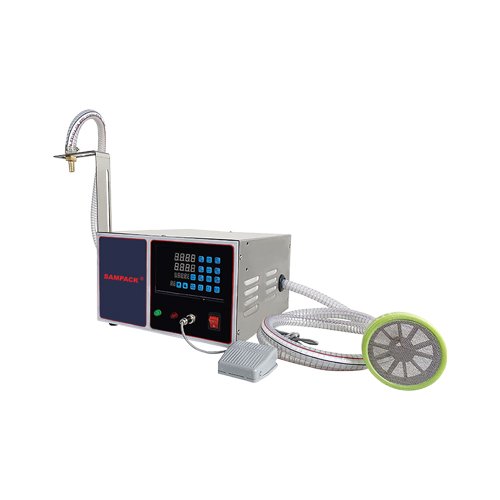 Flagship Model
High Viscosity Liquid & Paste Filling Machine
Engineered with a heavy-duty pneumatic piston drive, oversized rotary valve ports, and Teflon/Viton seal packages. Designed specifically for viscous pastes, thick sauces, creams, gels, and chemical emulsions.
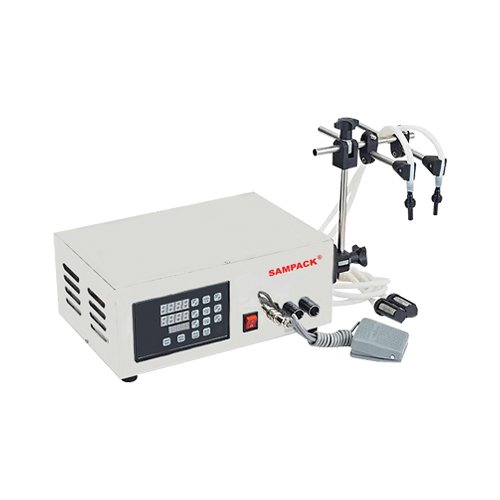 High Speed
Double Head Digital Viscous Liquid Filling Machine
Features twin synchronized filling channels driven by digital servo controls. Offers double the output for semi-viscous beverages, syrups, cosmetic gels, and essential oil blends with zero cross-contamination.
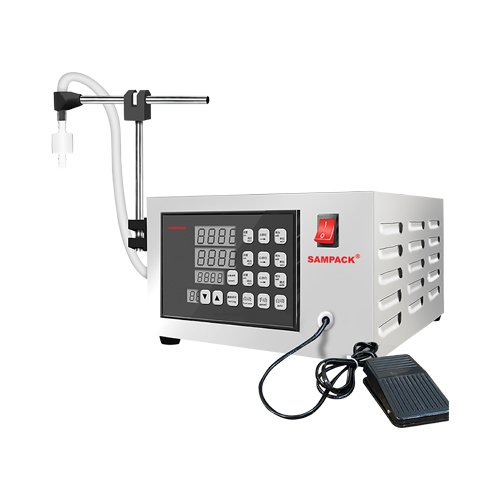 SME Favorite
Single Head Precision Liquid & Gel Filler
Compact, versatile benchtop dosing machine optimized for small-batch laboratory trials, pilot production, and boutique cosmetic or specialty sauce bottling lines requiring quick changeover.
4. Future Technological & Engineering Development Trends (2026–2030)
The industrial liquid packaging sector is undergoing a rapid transition toward digital connectivity, adaptive automation, and resource-efficient processing. Procurement officers and plant managers must invest in machine architectures capable of integrating next-generation technological advancements:
A. Closed-Loop Servo Feedback & Dynamic Viscosity Compensation
Conventional pneumatic fillers rely on fixed mechanical limit switches to govern stroke length. Next-generation Sampack filling machinery incorporates closed-loop servo-actuated ball screws paired with real-time torque sensors. If ambient facility temperatures fluctuate during a shift—causing fluid viscosity to increase—the system automatically adjusts stroke speed acceleration curves and back-pressure limits to maintain exact volumetric accuracy without operator intervention.
B. Smart IoT Edge Monitoring & Predictive Seal Maintenance
High viscosity filling subjects piston seals, O-rings, and rotary valves to elevated friction forces. Integration of Industry 4.0 IoT sensors allows real-time monitoring of pump displacement resistance, pneumatic air consumption variance, and thermal signatures. Predictive maintenance algorithms alert maintenance supervisors before seal degradation leads to batch under-filling or product contamination.
C. Hygienic CIP/SIP Automation & Sustainable Water Reduction
Sanitation downtime in food and pharmaceutical production directly impacts overall operational efficiency. Modern Sampack high viscosity lines feature automated Clean-In-Place (CIP) and Sterilize-In-Place (SIP) manifold loops. Using high-pressure spray balls and rapid-drain SS316L fluid channels, flush cycles reduce water and cleaning chemical consumption by up to 40% compared to manual teardowns.
5. Global Procurement Trends & Total Cost of Ownership (TCO) Analysis
Evaluating an industrial High Viscosity Liquid Filling Machine purely on initial Capital Expenditure (CAPEX) frequently results in unbudgeted long-term operational expenses (OPEX). Global buyers must conduct a structured Total Cost of Ownership (TCO) assessment across four core dimensions:
TCO Evaluation Framework for B2B Machinery Buyers
- Product Giveaway Mitigation: A filling machine operating at ±1.5% accuracy vs. Sampack's precision ±0.2% tolerance results in over 1,300 liters of wasted product per 100,000 units packed. Precision dosing directly protects product margins.
- Changeover & Toolless Disassembly Time: Sampack machines utilize quick-release sanitary Tri-Clamp connections, reducing line changeover between different viscosity batches from 2 hours down to 15 minutes.
- Utility Efficiency & Compressed Air Consumption: Advanced pneumatic cylinder cushioning and optional energy-efficient electric servo drives reduce facility air compressor loads by up to 30%.
- Regulatory Compliance & Validation Documentation: All international export machines come equipped with complete IQ/OQ (Installation Qualification / Operational Qualification) documentation packages, enabling seamless compliance with FDA 21 CFR Part 11 and EU GMP Annex 11.
Frequently Asked Technical Questions
Expert engineering answers for complex viscous fluid filling challenges
7. Why Global Industry Leaders Partner with Sampack India
Founded in 2001, Sampack India has grown into a globally recognized ISO 9001:2015 certified manufacturer and exporter of automated industrial packaging systems. Over more than 25 years of engineering innovation, we have deployed over 500,000 packaging machines worldwide across food processing, pharmaceuticals, cosmetics, and industrial chemicals.
Our manufacturing headquarters and regional technical support centers in Cochin, Coimbatore, Bengaluru, and Chennai house full-scale CNC machining centers, automated assembly bays, and application testing laboratories. Every high viscosity liquid filling machine undergoes rigorous dry-cycle stress testing and wet fluid performance trials prior to factory dispatch.
25+ Years Industrial Mastery
Over two decades of specialized machinery design for complex powder, granule, and heavy viscous liquid applications.
ISO 9001:2015 Quality Compliance
Strict quality management systems ensuring precise material traceability, SS316L food-grade standards, and CE compliance.
Global Export & On-Site Training
Complete international logistics support, export documentation, and on-site engineering installation with technician training.
Ready to Optimize Your Viscous Fluid Bottling Line?
Contact our engineering sales team today to request a custom quote, submit fluid samples for testing, or request a complete technical proposal.
Get a Quote