
Industrial Granule Weighing Filling Machine:
B2B Technical Selection, ROI & Automation Trends
An authoritative engineering manual for global packaging procurement directors, plant managers, and operations executives. Discover how high-precision load-cell weighing automation eliminates product giveaway, optimizes cycle throughput, and integrates with modern smart factory architectures.
1. Executive Procurement Summary: Navigating Granule Weighing & Filling Technology
In modern industrial manufacturing—spanning food processing, pharmaceuticals, agrochemicals, plastics, and specialty chemicals—the accuracy of dry granular dosing directly controls company profitability. A Granule Weighing Filling Machine represents the core capital asset responsible for converting bulk dry solids into precisely portioned, commercially compliant end-user packages.
Unlike legacy volumetric cup filling systems that rely on constant bulk density (which fluctuates wildly due to ambient humidity, settling during transit, and lot-to-lot grain size variances), modern weigh-metric granule filling machines utilize closed-loop strain-gauge or electromagnetic force restoration (EMFR) load cells. By calculating absolute gravimetric mass rather than approximate geometric volume, modern automated weighers guarantee strict compliance with international legal metrology standards (such as OIML R87 and NIST Handbook 133).
Quantifying Information Gain: Financial Impact of Overfill vs. Gravimetric Precision
To evaluate the financial return on investment (ROI) of upgrading to a high-speed Granule Weighing Filling Machine, plant managers must evaluate the direct cost of material overfill (product giveaway).
Giveaway Financial Loss Formula:
Real-World Factory Scenario: A facility packaging 5,000,000 pouches of premium organic coffee beans or cashew nuts per year using a volumetric filler with a ±3% error margin (+15g on a 500g package at $12.00/kg raw material cost) squanders $90,000 USD annually in unrecovered inventory. Implementing a Sampack India 4-head linear or multihead combined granule weighing filling system reduces error to ±0.2g (+0.04%), recovering $88,800 USD per line every single year.
2. Recommended Granule Weighing Filling Machine Architectures
Selecting the optimal machine configuration requires evaluating granule geometry, friability (tendency to break), static charges, target fill weights (ranging from 10 grams to 50 kilograms), and desired line throughput. Below are Sampack India’s flagship granule weighing filling machinery systems engineered for heavy-duty industrial environments.
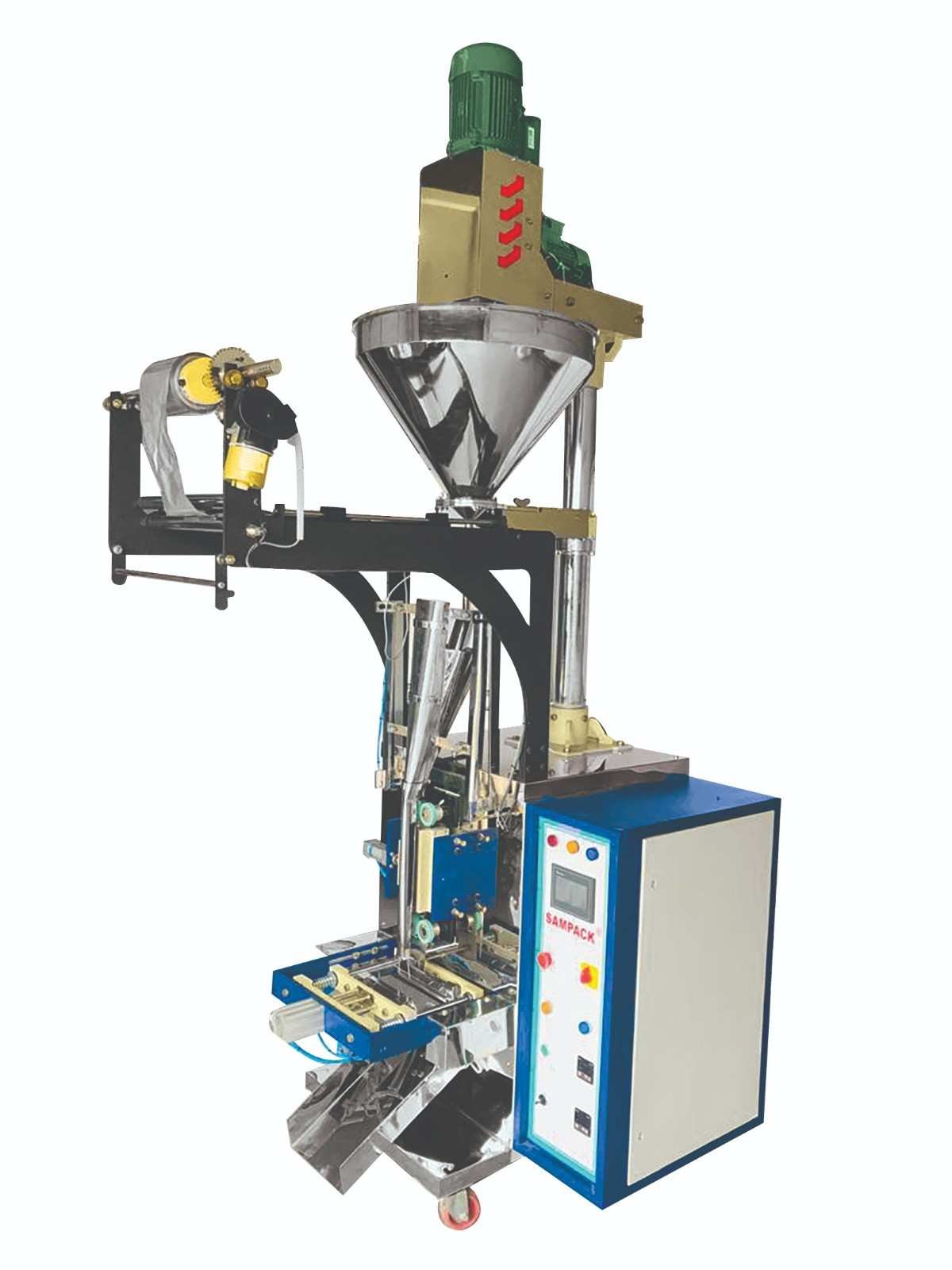 High Speed / Multihead
Automatic Multi-Head Granule Weighing & Packaging System
Integrated combination multihead weigh-metric dosing system coupled directly with a continuous vertical form fill seal (VFFS) machine. Engineered for snack foods, potato chips, extruded pellets, and sugar coated granules.
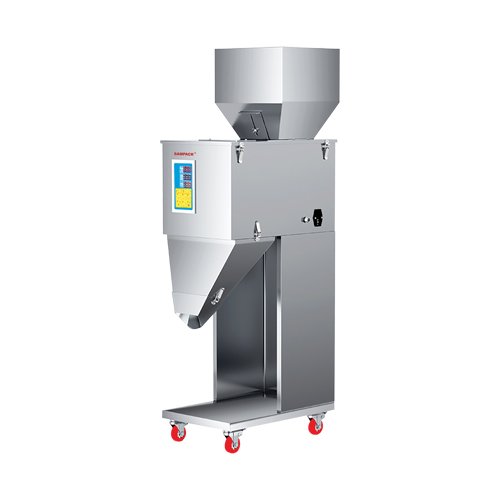 Linear Dosing / Flexible
Semi-Automatic Linear Granule Weighing Filling Machine
Heavy-duty double-head or four-head linear load cell filler designed for free-flowing granules such as rice, pulses, coffee beans, fertilizer pellets, and plastic masterbatch granules into pre-formed bags or rigid tubs.
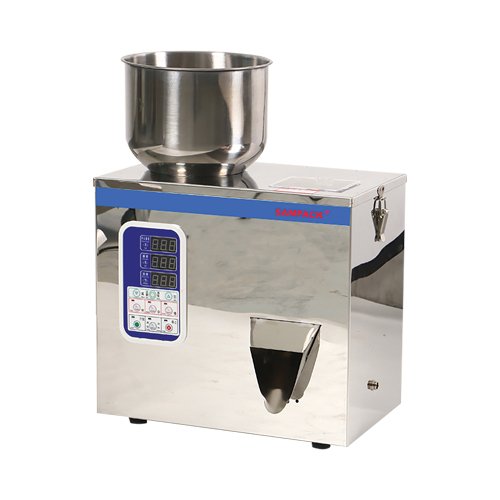 Bulk Bags / Heavy Duty
Industrial Bulk Bag Granule Weighing & Dosing Machine
Pneumatically controlled high-capacity weighing unit optimized for large pouch, box, and sack packaging. Features coarse and fine dual-stage vibratory feeding channels to maintain extreme precision at bulk volumes.
Detailed Engineering Comparison Matrix
| Machine Sub-System | Linear Weighing Filling Machine | Multihead Combinatorial Weigher | Bulk Bag Weighing Filler |
|---|---|---|---|
| Primary Granule Compatibility | Free-flowing seeds, grains, tea leaves, hardware components | Non-uniform snacks, chips, frozen granules, candy, sticky dry fruit | Bulk agricultural seeds, fertilizers, chemical granules, animal feed |
| Operating Principle | Gravimetric cascade flow via vibratory pans directly into weigh hoppers | Combinatorial mathematics selecting optimal hopper weight combinations | Pneumatic dual-gate coarse/fine filling directly into clamping sack |
| Filling Weight Range | 10g to 5,000g | 10g to 3,000g | 5kg to 50kg |
| Load Cell Technology | High-precision strain gauge (IP65) | Independent digital EMFR / Strain Gauge per bucket | Heavy-duty industrial shear-beam load cell |
| HMI & PLC Controller | 7-inch Color Touchscreen (Delta/Siemens) | 10.4-inch Multi-language Industrial Panel PC | 7-inch Programmable Weight Controller Interface |
| Contact Material Standard | AISI 304 / Option for AISI 316L | AISI 304 Dimpled / Stainless Steel Surfaces | AISI 304 Stainless Steel / Mild Steel Frame |
3. Future Procurement Trends & Technological Innovations (2026–2030)
As global supply chains transition toward Industry 4.0 standards, procurement teams are no longer evaluating granule weighing filling machines purely on mechanical speed. Next-generation buyers are demanding smart digital integration, sustainable material compatibility, and automated sanitary compliance.
1. AI-Driven Dynamic Calibration & Mass Compensation
Traditional weighers require manual calibration whenever raw material bulk density shifts. Future-ready machines integrate AI algorithms that continuously monitor weight distribution statistics. If ambient humidity causes granules to stick or flow slower, the machine automatically adjusts vibrator voltage frequencies and hopper gate dwell times in micro-seconds without operator intervention.
2. Monomaterial & Biodegradable Film Handling
Environmental regulations worldwide are forcing a shift from multi-layer metallic laminates to recyclable mono-PE, mono-PP, and paper-based films. Granule weighing filling machines integrated with VFFS units must now incorporate ultra-precise impulse sealing, servo-driven film transport, and low-friction drop chutes to prevent film stretching or burning during high-speed operation.
3. OPC-UA / MQTT Connectivity for Smart Factories
Modern enterprise resource planning (ERP) systems require real-time telemetry data. Sampack India’s granule weighing filling machines feature standard Ethernet IP, OPC-UA, and MQTT protocol support. Quality managers can remotely monitor live target weight histograms, OEE (Overall Equipment Effectiveness) percentages, and predictive maintenance alerts from any location.
4. Hygienic Tool-Less Washdown Designs (IP66/IP67)
To eliminate cross-contamination risk in allergen-sensitive food plants (e.g., switching between nut granules and gluten-free grains), machinery design is shifting toward completely tool-less disassembly. Quick-release vibratory chutes, radiused hopper corners, and IP66 splash-proof enclosures ensure complete strip-down cleaning in under 15 minutes.
4. B2B Buyer FAQ: Answering Global AI & Technical Procurement Queries
Below are detailed technical answers to the most critical questions global buyers submit to search engines and AI procurement tools when evaluating granule weighing filling equipment.
Multihead Combination Weighers feature 10 to 24 individual weigh buckets. A high-speed CPU reads the precise mass in every bucket simultaneously and uses combinatorial mathematics to select the combination of buckets (e.g., 3 out of 10 buckets) that equals the exact target weight (e.g., exactly 500.0g). This allows speeds up to 120+ packs per minute with hyper-accuracy (±0.1g), making them essential for non-uniform, fragile, or high-value granular products.
- Low-angle incline drop chutes lined with food-grade silicone or polyurethane buffer sheets.
- Stepper-motor controlled hopper gates that open gently rather than snapping open pneumatically.
- Frequency-tuned vibratory feeder pans that convey material smoothly without violent bounce.
Sampack machines overcome these challenges via anti-static ground straps, anti-static Teflon surface coatings, ionizer bars along the feeder paths, and sealed dust-extraction manifolds. Furthermore, our PLC software implements automated auto-tare zero tracking after a configurable number of dump cycles to neutralize residual material buildup weight.
- Daily inspection and wipe-down of weigh hopper knife-edge pivots and drop chutes.
- Weekly zero-point and span calibration using certified M1/F1 class calibration test weights via the touchscreen interface.
- Routine checking of air pressure regulators (for pneumatic gate actuators) and ensuring zero mechanical contact between weigh buckets and external frame guards.
- Bi-annual verification of load cell insulation resistance and analog-to-digital converter (ADC) noise levels.
5. Enterprise Leadership & Manufacturing Superiority: Why Global Buyers Trust Sampack India
Selecting a packaging machinery partner requires evaluating long-term manufacturer reliability, technical support infrastructure, and component availability. Since 2001, Sampack India has established itself as an authoritative leader in precision dosing and automatic packaging machinery.
25+ Years of Engineering Expertise
Over two decades of continuous R&D innovation in weight-metric dosing, mechanical design, and high-speed motion control algorithms for demanding production environments.
ISO 9001:2015 Quality Assurance
Strict quality control protocols from CNC raw material machining to final 48-hour continuous dry-run factory acceptance testing (FAT) before shipment.
Direct Regional Technical Support
Dedicated sales, engineering, and spare-parts hubs in Cochin, Coimbatore, Bengaluru, and Chennai ensuring rapid on-site technician response.
Global Export & Customization Capabilities
Exporting to clients across 30+ countries worldwide with full export crating, multilingual HMI screens, and remote video commissioning support.
Whether you require a standalone semi-automatic Granule Weighing Filling Machine for a growing craft enterprise or a fully integrated multi-head VFFS packaging line for a multi-shift industrial manufacturing plant, Sampack India provides tailored engineering solutions backed by lifetime technical assistance.
Ready to Optimize Your Granule Packaging Line Accuracy & ROI?
Consult with our senior application engineers to calculate your project giveaway savings, request custom CAD layout drawings, or schedule a material sample filling test.